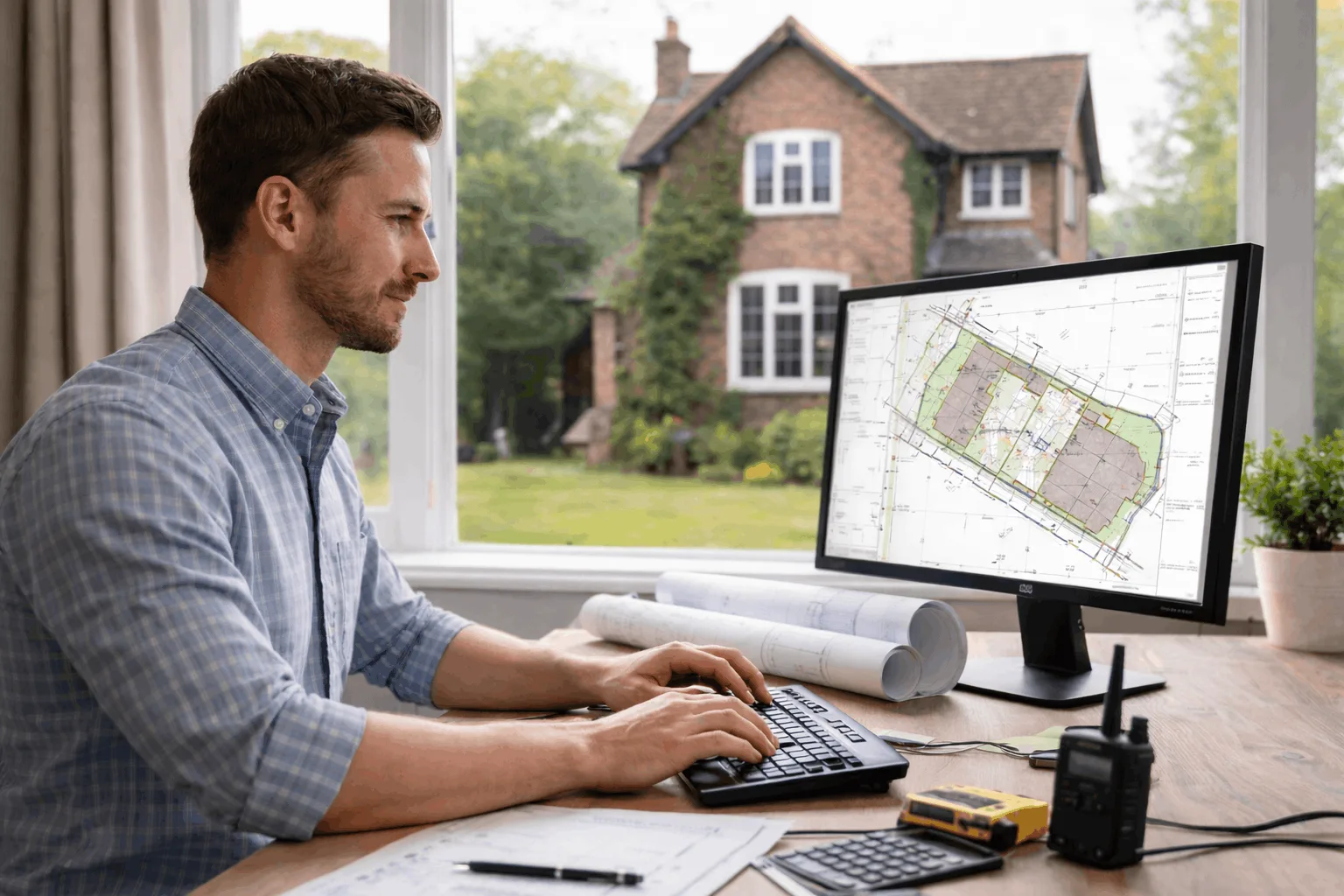
We get asked about this a lot, usually by people who have been quoted for a "desktop survey" and aren't sure what they're getting. A desktop survey is a report done without anyone visiting the property. Desktop research is the background checking a surveyor does before they go out to inspect. The names are close enough that clients, buyers and sometimes surveyors themselves use them interchangeably.
Mixing them up can cause problems. A client might pay for a desktop report thinking it covers the condition of the building, when it doesn't. Or they might not realise how much checking goes on before a surveyor turns up for a Level 2 or Level 3 inspection.
What is a desktop survey?
A desktop survey is a report produced without anyone physically inspecting the property. The surveyor or valuer works entirely from data, records and imagery, then gives a conclusion: usually a value, a risk rating or a set of measurements.
Common examples in surveying practice include:
- Desktop valuations, which lenders often use for remortgages or lower-risk lending. The valuer works from comparable sales, Land Registry data, EPCs, listing photos and automated valuation models.
- Desktop measured surveys, where floor plans or areas are drawn from existing drawings, planning portal plans or the client's own dimensions instead of being measured on site.
- Desktop environmental or flood reports covering flood risk, contaminated land, subsidence, radon and mining. Conveyancers buy a lot of these.
- Desktop portfolio reviews for investors, housing associations or insurers who need a rough picture across many properties.
In each case the desktop report is what the client receives and acts on. It's quick and cheap, but nobody has looked at the building, so its condition, any defects and any alterations that aren't on record are unknown.
A desktop survey cannot tell you about damp in the cellar, a failing roof, an unauthorised extension or a neighbour's tree lifting the drains. Reputable surveyors state these limitations clearly in the report's terms.
What is desktop research for a surveyor?
Desktop research is the checking a surveyor does before going on site, and sometimes afterwards when something needs following up. The client doesn't buy it separately. It goes into the main report, whether that's a RICS Level 2 or Level 3 survey, a valuation, a party wall award or a schedule of dilapidations.
Before a typical residential inspection, a surveyor will usually check:
- Planning and building control history on the council portal: extensions, loft conversions, refused applications.
- Whether the property is listed, in a conservation area, covered by an Article 4 direction or has protected trees nearby.
- Flood maps and surface water risk, radon, coal and other mining, and the local geology (shrinkable clay in particular).
- The Land Registry title plan, rights of way and anything odd about the boundaries.
- The EPC, historic maps and old estate agent photos, which often show how the house has been altered.
- Comparable sales and local market conditions, if there's a valuation element.
What turns up affects how the inspection is done. A watercourse at the bottom of the garden means paying closer attention to damp and drainage. Historic maps showing a pond or quarry on the site are a reason to look carefully for movement. A rear extension with no record of consent gets flagged for the conveyancer.
On site, the surveyor checks the records against the building. Records are often wrong or incomplete, and the inspection is where that gets picked up.
Side by side
| Feature | Desktop survey | Desktop research |
|---|---|---|
| What it is | A standalone report or valuation | Preparation behind an inspection-based report |
| Site visit | None | Yes, research supports it |
| Who sees it | The client receives it directly | Mostly internal; findings appear in the final report |
| Typical use | Remortgages, portfolio reviews, quick risk checks | Home surveys, valuations, building and commercial surveys |
| Condition and defects | Not assessed | Assessed on site, guided by the research |
| Cost and speed | Low cost, often same day or within days | Built into the fee for the full survey |
| Main risk | Relies on records that may be wrong or out of date | Low, as records are checked against the building itself |
Why your desktop research needs to be defensible
If a buyer later finds an unconsented extension, a flood history or old mine workings, one of the first things anyone will ask is what you checked before the inspection and what you did about it. Your desktop research is part of your evidence, so it's worth treating it that way.
In practice that means:
- Doing the same checks in the same order on every job, whoever in the practice picks it up.
- Keeping a record of which sources you looked at, when, and what they showed for that particular property.
- Writing the findings up in wording that fits a Level 2 or Level 3 report without overstating the risk.
Most surveyors we speak to know this already. The problem is time. Doing it by hand means a dozen browser tabs, a lot of copying and pasting, and evenings spent on admin, and when the diary is full, steps get missed.